Is SEO Dead in 2026? What AI Search Really Changed

TL;DR: SEO is not dead, it has changed. AI search answers more questions on the page, so some informational clicks dropped, but people still search and the work that ranks you now also gets you cited by AI. Focus on action-driven searches and AI citations, and SEO matters more now, not less.
Every few years someone declares SEO dead. This time it is AI search, and the claim feels more real because the results page genuinely looks different. So let us be honest about it. AI search has changed SEO in real ways, but “dead” is the wrong word. This guide looks at what actually changed, what the data shows, and what it means for your business.
Quick answer: No, SEO is not dead. AI search answers more questions directly, so some informational clicks have fallen. But people still search in huge numbers, and the same work that ranks you, helpful content, expertise and trust, is now also what gets you cited inside AI answers. SEO has not died. It has spread across more surfaces, and it matters more, not less.
Key takeaways
- SEO changed, it did not die. People still search; the surfaces just multiplied.
- Some clicks dropped. Informational queries lose the most to AI summaries.
- Action searches are safe. Buying and local searches still drive real visits and leads.
- The fix is quality. Helpful, trusted, quotable content wins in both search and AI.
What AI search actually changed
Three real things changed, and it helps to name them honestly.
First, more answers happen on the page. AI Overviews and AI Mode answer many questions without a click, especially simple informational ones. If your traffic depended on quick-answer content, you have felt this.
Second, the cited source is often not the top result. AI breaks a question into parts and quotes whichever source answers each part best. Ranking first no longer guarantees the visit or the citation.
Third, trust and expertise matter more. Google now treats mass-produced AI content with no human oversight as spam. Thin content that used to scrape by now struggles.
What the data says about zero-click
The scary headline is “zero-click search.” Here is the honest version. A 2025 Pew study found that click-through roughly halved when an AI summary was present, around 8% versus 15% without one. Google disputes the method, and the picture varies by query type, but the direction is real: AI summaries take some clicks.
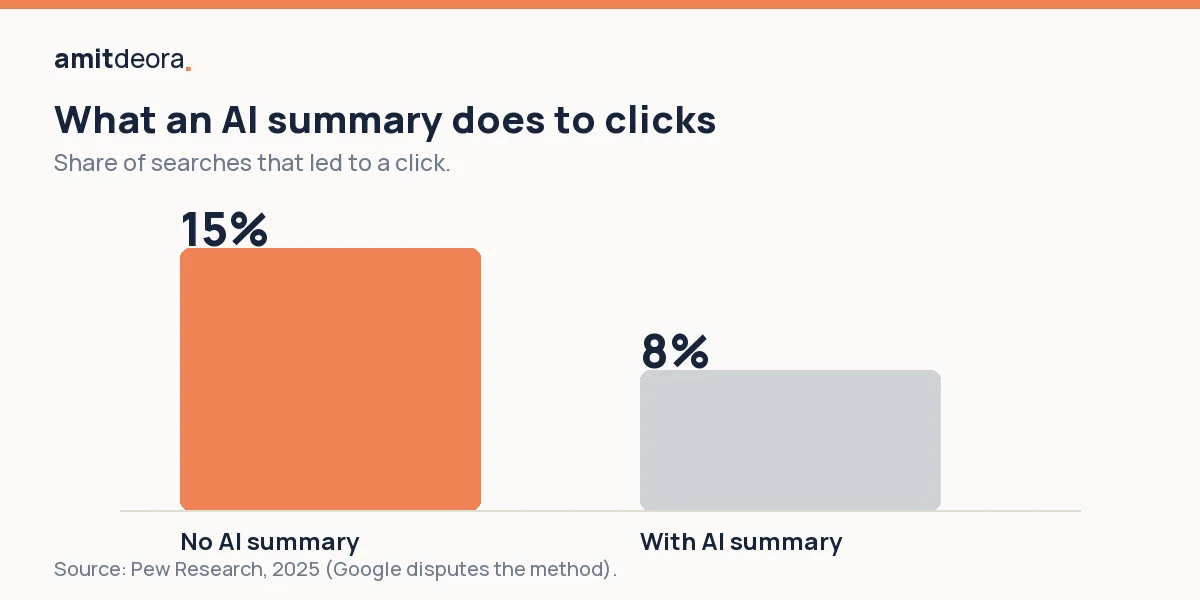
But notice what loses clicks: quick informational questions, the kind that were never worth much to a business anyway. The searches that matter, “best plumber near me”, “accountant for small business”, “buy X online”, still send people to websites and still turn into leads and sales. The sky is not falling. The low-value traffic is thinning, and the high-value traffic is mostly intact.
Why SEO matters more now, not less
Here is the part the doom headlines miss. The work that gets you cited by AI is the same work that ranks you on Google. Helpful content, clear answers, real data, expertise and trust. So SEO is no longer just about blue links. It is the foundation for being visible everywhere people get answers: search results, AI Overviews, AI Mode, ChatGPT and Perplexity.
That means pulling back on SEO now loses you ground on two fronts at once. The businesses that invest in genuinely useful, trustworthy content are the ones showing up in both normal search and AI answers. This is the heart of generative engine optimization.
What still works, and what does not
The honest, people-first playbook works better than ever:
- Still works: helpful content that answers real questions, answer-first writing, real expertise and author identity, local SEO and reviews, topical depth, quotable data, trusted mentions.
- Works less: thin keyword-stuffed pages, mass AI content with no human editing, chasing rankings over usefulness, quick-answer filler with no depth.
The shift rewards quality and punishes shortcuts, which is a good thing for any business that does real work.
What to do about it
Do not panic, and do not quit SEO. Adjust:
- Focus on action searches. Put your effort into the buying and local terms that still drive leads, not quick-answer filler.
- Write answer-first. Lead with the answer so you can be the cited source.
- Back it with data. Real numbers and sources get quoted by AI.
- Build trust and depth. Expertise, reviews and topical clusters, not thin pages.
- Track AI citations. Treat being cited by AI as a metric alongside rankings and traffic.
A real example
Rather than argue, here is proof the new way works. For an AI-tools platform I worked with, AI assistants became the number-one traffic channel over 90 days (GA4), ahead of direct and organic. That is not a dying channel. It is SEO showing up in a new place. You can see the source-labelled numbers in my case studies.
The bottom line
SEO is not dead. It grew up. AI search took some low-value informational clicks, but people still search for the things that matter, and the work that ranks you now also gets you cited by AI. Focus on action-driven searches, write answer-first, back it with real data, and build genuine trust and depth. Do that and AI search becomes an opportunity, not a threat. To act on it, read the GEO guide and the plain-English AEO vs SEO vs GEO explainer.
Worried about what AI search means for your traffic? I am one click away for an honest look.
Frequently asked questions
Is SEO dead in 2026?
No. SEO has changed, not died. AI search answers more questions on the results page, so some informational clicks have dropped. But people still search, and the work that ranks you, helpful content, trust and authority, is now also what gets you cited by AI. SEO matters as much as ever, just across more surfaces than blue links alone.
Has AI search killed organic traffic?
It has reshaped it, not killed it. One study found click-through roughly halved when an AI summary appears, though Google disputes the method. Informational queries lose the most clicks, while buying and local searches still drive visits and leads. The fix is to focus on the searches that lead to action and to optimize for AI citations, not just clicks.
Should I still invest in SEO with AI search growing?
Yes, and arguably more. The same content and trust signals that rank you on Google are what get you cited by ChatGPT and AI Overviews. SEO is now the foundation for visibility across both normal search and AI answers. Pulling back on SEO means losing ground on both at once, which is the opposite of what the shift calls for.
What kind of SEO still works in the AI era?
The honest, people-first kind. Helpful content that answers real questions, clear answer-first writing, real expertise and trust, local SEO and reviews, and topical depth. Thin, keyword-stuffed content aimed at gaming rankings works less than ever. Google now treats mass AI content with no human oversight as spam, so quality and expertise matter more.
What is the future of SEO?
SEO is becoming visibility optimization across every place people get answers: search results, AI Overviews, AI Mode, ChatGPT and Perplexity. The fundamentals stay the same, but the emphasis shifts toward quotable answers, clear brand identity and trusted mentions. The businesses that win will be the ones that are genuinely useful and clearly trustworthy.