Generative Engine Optimization (GEO): How to Get Cited by AI Search in 2026
TL;DR: GEO is the work of getting your content cited by AI search like ChatGPT, Perplexity and Google AI Overviews. Google says it is still SEO at heart, so skip the gimmicks. What works: clear answers, quotable facts, real statistics, cited sources, strong topical authority and trusted brand mentions. Track citations as their own metric.
More of your customers now ask an AI assistant instead of scrolling a list of links. They type a question into ChatGPT or Google’s AI Mode and get one synthesized answer that quotes a handful of sources. Generative engine optimization, or GEO, is how you become one of those quoted sources. This is a practical, honest guide: how AI search picks who to cite, what genuinely works, and what to ignore.
Quick answer: GEO is the practice of structuring your content so AI search tools can find, understand and cite it. It goes by several names (GEO, AEO, AI SEO, LLM optimization), but the goal is the same: get quoted inside AI answers. Google’s own guidance says AI search is still SEO, so there is no magic markup. The levers that work are clear answers, quotable data, cited sources, topical depth and trusted brand mentions.
Key takeaways
- GEO is SEO with a shift in emphasis. Google confirms AI search runs on the same ranking and quality systems.
- Quotable beats clever. Adding quotations, statistics and sources gave the biggest citation gains in testing.
- Skip the gimmicks. llms.txt is inert and FAQ schema no longer earns a rich result. Do not pay for either.
- Track citations continuously. They rotate fast, so a one-off check means little.
What is generative engine optimization?
GEO is the practice of making your content easy for AI systems to find, understand and quote. When someone searches Google the old way, they get blue links. When they ask ChatGPT or Perplexity, they get one written answer built from several sources. GEO is about being one of those sources.
You will see the same idea called answer engine optimization (AEO), AI SEO, or large language model optimization (LLMO). The industry has not settled on one name. They all describe the same goal: get your business cited in AI answers.
The honest truth: GEO is still SEO
Here is what most “GEO experts” will not tell you. In its AI-optimization guide, Google is clear that AI search is still SEO. AI Overviews and AI Mode run on the same ranking and quality systems as normal Search. There is no AI-only markup to add, no special file to publish, and no secret format.
That is good news. It means the work you do to rank well, helpful content, clear structure, real expertise and trust, is the same work that gets you cited by AI. GEO is a change in emphasis, not a new discipline you have to start from zero.
How AI search picks its sources
AI search does not just grab the top result. It breaks your question into smaller sub-questions, finds sources for each, and builds one answer. This is why strong rankings help but do not guarantee a citation. The page Google ranks first is often not the page the AI quotes. One analysis found that the overlap between AI Overview citations and the top 10 organic results fell from about 76% in mid-2025 to around 38% by early 2026, after Google switched its AI models.
The lesson is simple. Ranking is still worth it, but your real goal is to be the clearest, most quotable source for the specific sub-questions buyers ask, not just to hold the number-one spot.
What actually works to get cited
This is where real data beats opinion. A Princeton-led study tested which tactics increase how often AI engines cite a source. The biggest gains came from a few specific moves.
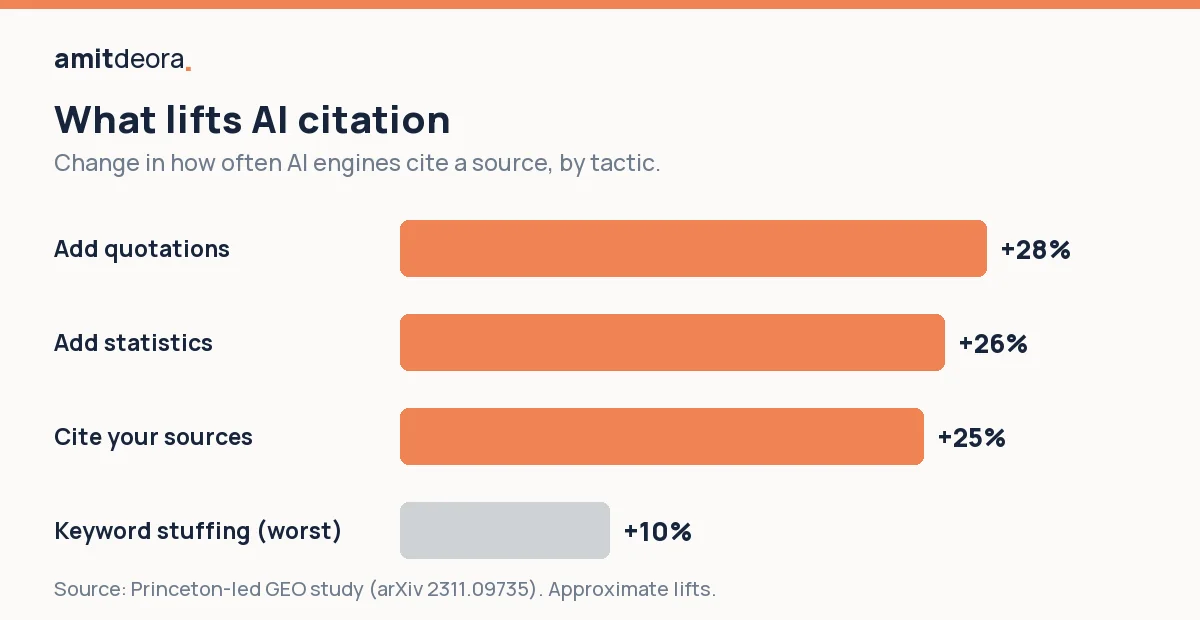
- Add direct quotations. Quoting an expert or a source lifted visibility by about 28%.
- Add statistics. Real numbers lifted it by about 26%.
- Cite your sources. Linking to where your facts come from lifted it by about 25%.
- Write clearly. Plain, fluent language helped.
- Avoid keyword stuffing. It was the worst-performing tactic, so it hurts more than it helps.
In plain terms: give clear answers, back them with real numbers and quotes, and show where your facts come from. That is also just good writing, which is the point.
Each AI engine cites differently
Not every engine trusts the same sources, so a one-size answer misses. A large study of AI citations found clear patterns:
| AI engine | Tends to cite |
|---|---|
| ChatGPT | Wikipedia and established reference sites |
| Perplexity | Reddit and community discussion |
| Google AI Overviews | Reddit, YouTube and Quora |
| B2B answers | LinkedIn and professional sources |
The takeaway for a business: your own clear, trusted content matters, and so does being talked about in the places each engine trusts, like real reviews, community mentions and a strong professional profile.
The GEO checklist
Putting it together, here is what to actually do:
- Answer first. Put a clear, direct answer at the top of every page, then the detail.
- Make facts quotable. Short, self-contained statements with real numbers an AI can lift cleanly.
- Cite your sources. Link to the data and research behind your claims.
- Build topical authority. Cover a subject deeply with a content cluster, not one thin page. AI prefers sources that show real depth.
- Be clear about who you are. Named author, real credentials and Organization and Person details, so engines can identify your brand.
- Keep schema for parsing, not rich results. FAQ and Article schema still help AI read your content, even though FAQ no longer earns a visual in search.
- Let the right AI crawlers in. Allow search bots like OAI-SearchBot, Claude-SearchBot and PerplexityBot so your content can be cited.
- Earn trusted mentions. Reviews, press and professional profiles build the brand signals AI leans on.
What not to waste time on
Plenty of GEO advice is noise. Skip these:
- llms.txt. Google confirmed it has no effect on Search. Only about 10% of sites publish it and almost no AI requests use it. Do not pay for it as a deliverable.
- FAQ schema for rich results. Google retired FAQ rich results in May 2026. The markup can still help AI parse your page, but it will not add stars or dropdowns in search.
- Keyword stuffing. It was the worst tactic in testing and risks a spam penalty.
- AI-only “chunking” tricks. Google says no special formatting is required. Clear content wins.
How to measure GEO
Treat AI citations as their own metric, alongside rankings and traffic. Check whether your brand is mentioned and cited across ChatGPT, Perplexity, Google AI Overviews and AI Mode. The key habit is to monitor continuously, because citations rotate fast. One study found ChatGPT Search citations changed about 74% week to week, AI Mode about 56%, and AI Overviews about 5%. A single check on one day tells you almost nothing.
A real example
I will give you a result rather than a promise. For an AI-tools platform I worked with, AI assistants became the number-one traffic channel, ahead of direct and organic, over a 90-day window (GA4). It happened by doing the basics in this guide: clear, quotable content with real depth, strong trust signals, and letting the right AI crawlers in. You can see the source-labelled numbers in my case studies.
The bottom line
Generative engine optimization is not a new magic trick. It is SEO with a sharper focus on being quoted, not just ranked. Give clear answers, back them with real data and sources, build genuine topical depth, be clear about who you are, and earn trusted mentions. Skip the gimmicks like llms.txt. Then track your AI citations as their own number. To go deeper, see how to rank in Google AI Overviews, how to get cited by ChatGPT, and the plain-English AEO vs SEO vs GEO explainer.
Want help getting your business cited by AI search? I am one click away.
Frequently asked questions
What is generative engine optimization (GEO)?
GEO is the practice of structuring your content so AI search tools like ChatGPT, Perplexity and Google AI Overviews can find, understand and cite it in their answers. You may also see it called answer engine optimization (AEO), AI SEO or LLM optimization. They all mean the same thing: getting your business quoted inside AI-generated answers, not just ranked in blue links.
Is GEO different from SEO?
Mostly no. Google's own AI-optimization guide says AI search is still SEO, and needs no special markup or AI-only files. GEO is a shift in emphasis, not a new discipline. It leans harder on clear answers, quotable facts, cited sources and trusted brand signals. The fundamentals that rank you in Google are the same ones that get you cited by AI.
What actually works to get cited by AI?
A Princeton-led study found the biggest gains came from adding direct quotations (about +28% visibility), adding statistics (about +26%) and citing your sources (about +25%). In plain terms: give clear, quotable answers backed by real data and sources. Keyword stuffing was the worst-performing tactic. Strong topical authority and brand mentions across the web also help a lot.
Do I need llms.txt or special schema for AI search?
No. Google confirmed llms.txt has no effect on Search, and its own guide says no AI-only markup is required. FAQ schema no longer earns a rich result either, though it can still help AI parse your content. Do not pay for llms.txt as a deliverable. Spend that effort on clear content, real expertise and trusted mentions instead.
How do I measure GEO?
Track whether your brand is mentioned and cited across ChatGPT, Perplexity, Google AI Overviews and AI Mode, and treat that as its own metric alongside rankings and traffic. Citations rotate fast, so monitor continuously, not once. One study found ChatGPT Search citations changed about 74% week to week, versus about 5% for AI Overviews, so a single check tells you very little.