How to Rank in Google AI Overviews and AI Mode (2026)
TL;DR: Google AI Overviews and AI Mode run on the same ranking systems as normal Search, so strong, helpful content still matters. To get cited, answer specific questions clearly and first, back them with real data, show who you are, and build topical depth. AI Overviews and AI Mode are different engines, so optimize for both.
Google’s search results do not look like they used to. For many questions, an AI answer now sits above the links, and Google’s AI Mode drops the links entirely. Getting your business named in those answers is the new version of ranking on page one. This guide explains how both work and the practical steps to get cited, based on Google’s own guidance and current data.
Quick answer: To rank in Google AI Overviews and AI Mode, keep doing strong SEO, then sharpen it for AI. Give clear, answer-first responses to the specific questions buyers ask, back them with real numbers and sources, make your brand and author identity clear, and build deep topical content. Because AI Overviews and AI Mode cite different sources, optimize for both rather than assuming one covers the other.
Key takeaways
- It is still SEO. AI Overviews run on Google’s normal ranking and quality systems.
- Answer the sub-question. Google splits a query into parts, so clear answers to specific questions win citations.
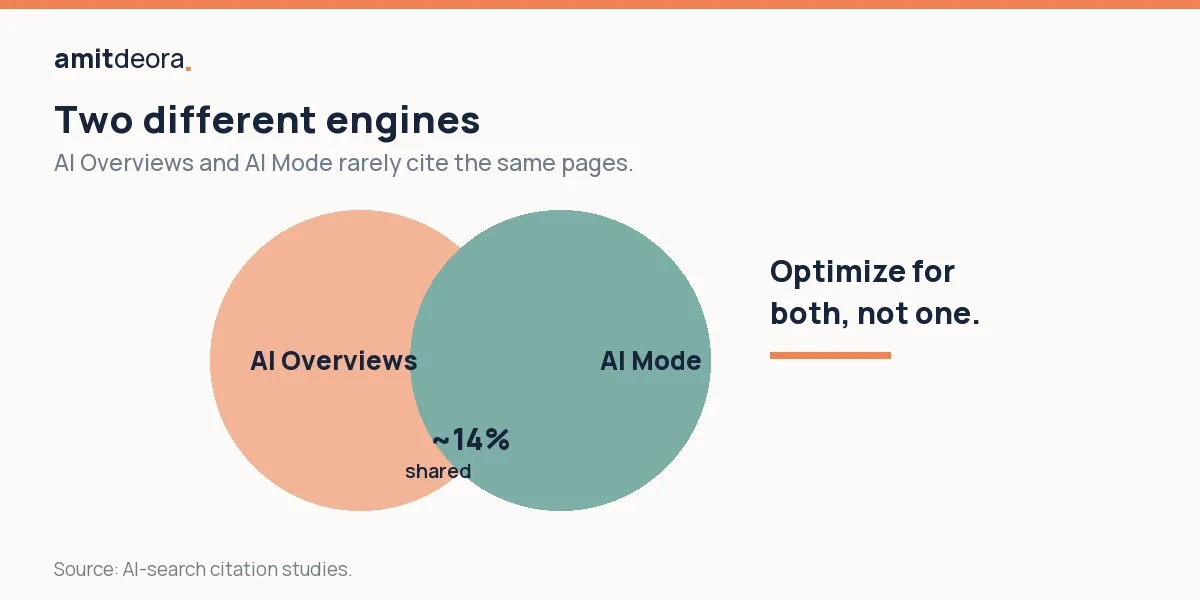
- Two engines, not one. AI Overviews and AI Mode share only about 14% of cited URLs. Optimize for both.
- Ranking is not enough. The top-ranked page is often not the one cited.
AI Overviews and AI Mode: what they are
These are two different surfaces, and the difference matters.
- AI Overviews are the AI-generated answer box that appears at the top of the results for many searches, above the normal links. The links still exist below.
- AI Mode is Google’s fully conversational search. It is powered by Google’s latest Gemini model and has grown to around a billion monthly users. It shows a written answer with citations and no blue links at all, so being cited is the only way to be seen.
Here is the catch most people miss. These two engines do not cite the same pages. Studies show they share only about 14% of the URLs they cite. So you cannot optimize for one and assume the other follows. You need both. This is part of the wider generative engine optimization picture.
How Google picks what to cite
Google does not just quote the top result. It breaks your question into smaller sub-questions, finds a source for each, and builds one answer. This is why a page ranked fifth can get cited while the number-one page is skipped. It happened to answer one sub-question more clearly.
The data backs this up. The overlap between AI Overview citations and the top 10 organic results fell from about 76% in mid-2025 to around 38% in early 2026 after Google updated its AI models. Strong rankings still help you get found, but clear answers to specific questions are what get you quoted.
How to get cited in AI Overviews and AI Mode
The work builds on normal SEO, with a few sharpened habits.
- Lead with the answer. Put a direct, one or two sentence answer at the top of each page or section, then the detail. AI lifts clean answers, not buried ones.
- Target real questions. Build content around the specific questions buyers ask, including the follow-ups. Think of the sub-questions behind the main one.
- Back claims with data. Real statistics and quotes get cited far more often than vague prose.
- Show who you are. Named authors, clear credentials, and Organization and Person details help Google trust and attribute your content.
- Build topical depth. A deep content cluster on your subject beats one thin page. AI favors sources that clearly know the topic.
- Keep your site healthy. Fast, mobile-friendly, crawlable pages. The technical basics still apply.
- Earn trusted mentions. Reviews, press and strong profiles build the authority Google leans on for AI answers.
Use Preferred Sources
Google added Preferred Sources inside AI Overviews and AI Mode. It lets people mark the sites they want to see more of, which then show up more often for them with a badge. It is a loyalty lever. If your audience values your content, encourage them to set you as a preferred source. It is slow, but it compounds.
Control the AI crawlers correctly
You decide who can use your content, and the controls split by job. Allow Googlebot and the search-focused AI crawlers so you can appear in AI answers. If you want to stop your content being used to train models, use Google-Extended to opt out of training only. Do not block the search crawlers, because that removes you from AI answers entirely, which is the opposite of what you want here.
What not to bother with
Save your effort. llms.txt has no effect on Google Search, confirmed by Google. FAQ rich results were retired in May 2026, so FAQ schema no longer adds a visual, though it can still help AI read your page. And there is no special “AI format” to chunk your content into. Google says clear, helpful content is what wins.
A real example
For an AI-tools platform I worked with, AI assistants became the number-one traffic channel over a 90-day window (GA4), ahead of direct and organic. The approach was the one above: clear, answer-first content with real depth and trust signals. You can see the source-labelled numbers in my case studies.
The bottom line
Ranking in Google AI Overviews and AI Mode is SEO, sharpened for AI. Keep your content strong and helpful, then answer specific questions clearly and first, back them with data, show who you are, and build real topical depth. Remember that AI Overviews and AI Mode are different engines, so optimize for both. Skip the gimmicks and track whether you are actually being cited. For the full picture, read the GEO guide, and to cover the other big engine, how to get cited by ChatGPT.
Want help getting your business into Google’s AI answers? I am one click away.
Frequently asked questions
How do I rank in Google AI Overviews?
You cannot buy a spot, but you can earn one. Google AI Overviews run on the same ranking systems as normal Search, so strong, helpful content still matters. On top of that, give clear answer-first responses to specific questions, back them with real data, show who you are, and build topical depth. AI Overviews pull from sources that rank well and answer the exact sub-question clearly.
What is the difference between AI Overviews and AI Mode?
AI Overviews are the AI answer box that appears above the normal results for some searches. AI Mode is Google's fully conversational search with no blue links at all. They are different engines: studies show they share only about 14% of the URLs they cite. So you need to optimize for both, not assume ranking in one covers the other.
Does ranking number one get me into AI Overviews?
Not reliably. Google breaks a question into smaller parts and finds sources for each, so the page it cites is often not the top-ranked one. The overlap between AI Overview citations and the top 10 organic results fell from about 76% in mid-2025 to around 38% in early 2026. Ranking helps, but answering the exact sub-question clearly matters more.
What are Preferred Sources in Google AI?
Preferred Sources is a feature inside AI Overviews and AI Mode that lets users mark websites they want to see more often. Marked sites get a badge and show up more frequently for that user. It rewards brands that build real loyalty, so encouraging your audience to prefer you is a genuine, if slow, visibility lever.
How do I stop Google using my content to train AI but still appear in AI search?
Use the crawler controls. Allow Googlebot and search-focused AI crawlers so you can appear in AI answers, and use Google-Extended to opt out of having your content used for model training. Blocking the search crawlers would remove you from AI answers, so only block the training-specific ones if that is your goal.