LLM SEO: How to Optimize Your Content for Large Language Models (2026)
TL;DR: LLM SEO is making your content easy for large language models like ChatGPT and Gemini to find, understand and cite. Models draw on training data and live retrieval, so be in the trusted sources they learn from and the results they retrieve. Give clear, quotable answers, build authority, and earn trusted mentions.
When a customer asks ChatGPT or Gemini a question, the model writes one answer and sometimes names its sources. LLM SEO is the work of making your business one of those named sources. It is closely related to generative engine optimization, and this guide explains how large language models actually find content and the practical steps to get mentioned.
Quick answer: LLM SEO is optimizing your content so large language models can find, understand and cite it. Models know things from their training data and also retrieve fresh results live, so you want to be in both. Give clear, quotable answers backed by data, build real authority on your topic, make your brand a clear entity, earn mentions on trusted sites, and let the AI crawlers in.
Key takeaways
- LLM SEO is SEO, sharpened. The same trusted, helpful content that ranks gets cited by models.
- Two paths in: training data and live retrieval. Aim to be in both.
- Quotable and trusted wins. Clear answers, real data and respected mentions get cited.
- Skip the gimmicks. llms.txt is inert and no AI-only markup is required.
How large language models build an answer
To optimize for LLMs, it helps to know how they answer. There are two sources of knowledge.
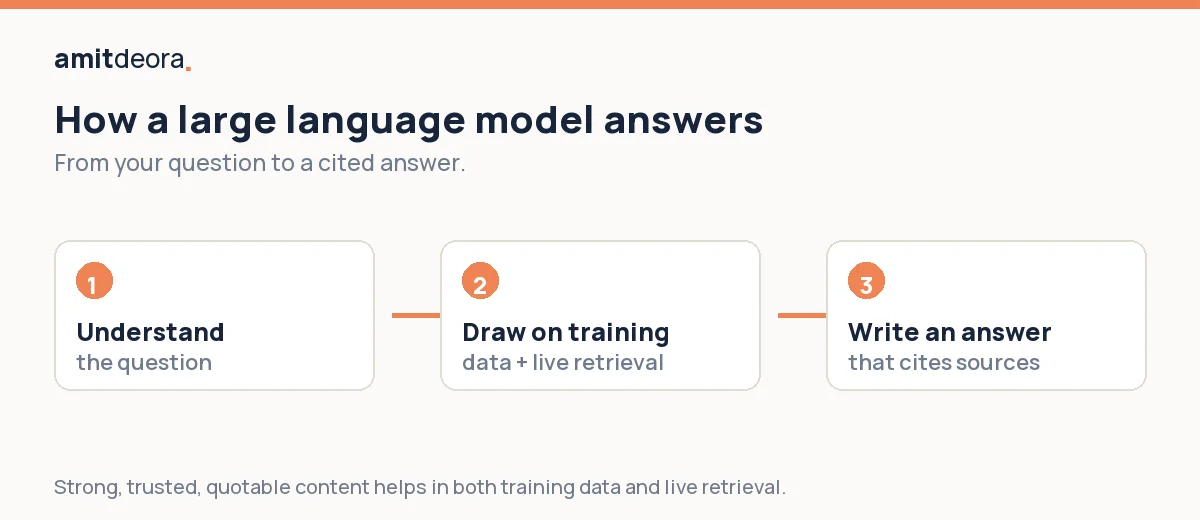
- Training data. The model learned from a large snapshot of the web. If your business is well described across trusted sources in that snapshot, the model may already know you.
- Live retrieval. For current or specific questions, the AI searches the web in real time, reads a few results, and builds its answer from them. This is where fresh, well-ranked, quotable content gets cited.
The lesson is simple. To be mentioned, you want to be in the trusted sources models learn from and in the live results they pull when someone asks. That means strong SEO and strong reputation, together.
The steps to optimize for LLMs
The work builds on normal SEO, with a sharper focus for AI.
- Lead with the answer. Put a clear, direct answer at the top of each page, then the detail. Models lift clean, self-contained statements.
- Back claims with data. Real numbers, quotes and cited sources get picked up far more than vague copy. A Princeton-led study found adding quotations, statistics and citations gave the biggest gains in AI visibility.
- Build real topical authority. Cover your subject deeply with a content cluster, not one thin page. Models favor sources that clearly know the topic.
- Be a clear entity. Named authors, credentials, and Organization and Person details, so models can tell exactly who you are.
- Earn trusted mentions. This matters a lot for LLMs. Get written about on respected sites, directories and, for B2B, LinkedIn. Reviews and press help too.
- Let the AI crawlers in. Allow search crawlers like OAI-SearchBot, Claude-SearchBot and PerplexityBot so your pages can be read and cited. Block training-only crawlers such as Google-Extended if you want to opt out of training.
Why trusted mentions matter so much
For LLMs, being talked about across the trusted web is as valuable as a link. When several respected sources describe your business the same way, the model treats that as a strong signal of who you are and what you are good at. That shapes both what it learned in training and what it finds in live retrieval.
So the single best off-site move is to earn genuine mentions where your industry and audience gather. The same work that builds your reputation with people builds it with the models. This is the core of the wider generative engine optimization approach.
What not to waste time on
Skip the shortcuts that do not work. llms.txt has no effect, confirmed by Google. There is no special schema that forces a citation, and FAQ rich results were retired in 2026, though the markup can still help a model parse your page. Keyword stuffing was the worst-performing tactic in testing. The things that work are clear content, real authority and trusted mentions.
Measure it
Treat AI mentions as their own metric. Check whether your brand is named and cited across ChatGPT, Gemini, Perplexity and Google AI Overviews, and watch it over time, because citations rotate fast. A single check tells you little. Track it the way you track rankings.
A real example
For an AI-tools platform I worked with, AI assistants became the number-one traffic channel over 90 days (GA4), ahead of direct and organic. It came from the basics here: clear, quotable content with real depth, strong trust signals, and open AI crawlers. You can see the source-labelled numbers in my case studies.
The bottom line
LLM SEO is not a new trick. It is SEO sharpened for the way models answer: by learning from trusted sources and retrieving fresh ones. Give clear, quotable answers backed by data, build genuine authority, be a clear entity, and earn trusted mentions. Skip the gimmicks, and track your AI mentions as their own number. To go wider, read the GEO guide, and for specific engines, how to get cited by ChatGPT and how to get cited by Perplexity.
Want help getting your business named by the big AI models? I am one click away.
Frequently asked questions
What is LLM SEO?
LLM SEO is the work of making your content easy for large language models like ChatGPT, Gemini and Claude to find, understand and cite. It is also called LLMO or generative engine optimization. The goal is to have your business mentioned inside AI-generated answers. It builds on normal SEO, with extra focus on clear answers, quotable facts and trusted mentions.
How do large language models find my content?
Two ways. Some of what a model knows comes from its training data, a snapshot of the web it learned from. The rest comes from live retrieval, where the AI searches the web in real time to answer your question and cites what it finds. To appear, you want to be in the trusted sources models learn from and in the live results they retrieve, so strong SEO and trusted mentions both matter.
How do I get my business mentioned by ChatGPT or Gemini?
Give clear, quotable answers backed by real data, build genuine authority on your topic, and earn mentions on trusted sites the models rely on, like Wikipedia, respected industry sources and, for B2B, LinkedIn. Make your brand a clear entity with named authors and Organization details, and allow the AI search crawlers so your pages can be read and cited.
Is LLM SEO different from normal SEO?
It overlaps heavily. Google says AI search is still SEO, and the same helpful, trusted content that ranks also gets cited by LLMs. The difference is emphasis. LLM SEO leans harder on quotable answers, cited data, clear brand identity and trusted mentions, because models synthesize answers rather than list links. Build strong SEO first, then sharpen it for LLMs.
Does structured data help LLM SEO?
It helps a little, not as a magic switch. Schema like Article and Organization helps AI parse who you are and what your content says, even though FAQ schema no longer earns a rich result. Google confirmed no special AI-only markup is required and that llms.txt has no effect. So use normal schema for clarity, and spend most of your effort on clear content and real trust.