SEO for Real Estate Agents: How to Get More Leads from Search (2026)

TL;DR: Real estate SEO gets your profile and site found when people search for an agent or homes in your area. Win it by owning hyperlocal searches: a complete Google Business Profile, real reviews, neighborhood pages and local content. You will not beat the big portals on broad terms, and you do not need to.
Buyers and sellers start on Google. They search “homes for sale in [neighborhood]”, “sell my house in [town]” or “best real estate agent near me”, long before they call anyone. SEO for real estate agents is how you get found at that moment. This is a plain, practical guide to what works, and how to win the local searches the big portals cannot.
Quick answer: Real estate SEO means getting found when people search for an agent or homes in your area. Do it by owning hyperlocal searches: (1) a complete Google Business Profile, (2) real reviews, (3) deep neighborhood and service pages, (4) local content like area guides and market updates. Skip broad national terms the portals own, and win the specific local searches that turn into listings.
Key takeaways
- Go hyperlocal. You win on neighborhood and agent searches, not broad national terms.
- Your profile and reviews matter. They drive the local pack and your personal brand.
- Neighborhood pages are your edge. Deep local content beats a thin portal listing.
- Measure booked leads, not traffic. A page that ranks but books no one is a vanity number.
Why real estate SEO is different
Most industries fight for the map pack. Real estate agents fight something extra: the big portals. Sites like the major listing portals dominate broad terms like “homes for sale”, and you will not outrank them there. The good news is you do not need to. Your edge is being the local expert the portals cannot personalize.
You win on hyperlocal, agent-specific searches: a named neighborhood, your own name, “best real estate agent in [town]”, and “sell my house in [suburb]”. These bring people who want someone who truly knows their area. That is where to put your effort.
What should an agent fix first?
Build your local presence and your neighborhood content before chasing anything broad.
| Priority | Focus | Why it comes first |
|---|---|---|
| 1 | Google Business Profile and local SEO | Drives the local pack and your personal brand |
| 2 | Reviews and reputation | Buyers and sellers pick an agent they trust |
| 3 | Neighborhood pages | Your real edge over the big portals |
| 4 | Service pages | Buying, selling and valuation searches |
| 5 | Local content | Area guides and market updates that attract movers |
Step 1: Google Business Profile
Your Google Business Profile builds your local presence and personal brand. Claim it and complete every field. Set the correct name, phone and area. Choose “Real estate agent” as the primary category, add real photos, and keep it active with posts about new listings and local news. For an agent, this profile is also where your reviews show, which is often what wins the client.
Step 2: Reviews
People choose an agent they trust with a huge decision, so reviews matter more here than in almost any field. In BrightLocal’s 2025 consumer review survey, only 4% of people said they never read online reviews, and Google was the top place they read them. Build a simple system to ask every happy buyer and seller for a Google review with a direct link, right after a successful close. Reply to every review, and never buy fake ones. For the full method, see how to get more Google reviews.
Step 3: Neighborhood pages
This is your real advantage. Build a genuine page for each neighborhood or suburb you serve, full of local detail the portals cannot match: what the area is like, schools, transport, price trends, and why people move there. Avoid thin pages that just swap the suburb name, because Google treats those as copies. Done well, these pages rank for the hyperlocal searches that bring serious buyers and sellers.
Step 4: Service pages
Give each core service its own page: buying, selling, and home valuations. A free valuation page, for example, targets sellers who are ready to list. Give each a clear title with the service and location, a real explanation of how you help, and an easy way to book a call or request a valuation. This is the same rule that helps any local business win its core terms: specific pages beat generic ones.
Step 5: Local content
Content is how you become the local authority. Write neighborhood guides, local market updates, and answers to the questions movers ask, like “is [suburb] a good place to live” and “how much is my home worth in [town]”. Then link each piece to the right service page so it feeds real leads. This content also earns the long-tail traffic and AI citations the portals rarely bother with.
SEO or paid ads for agents?
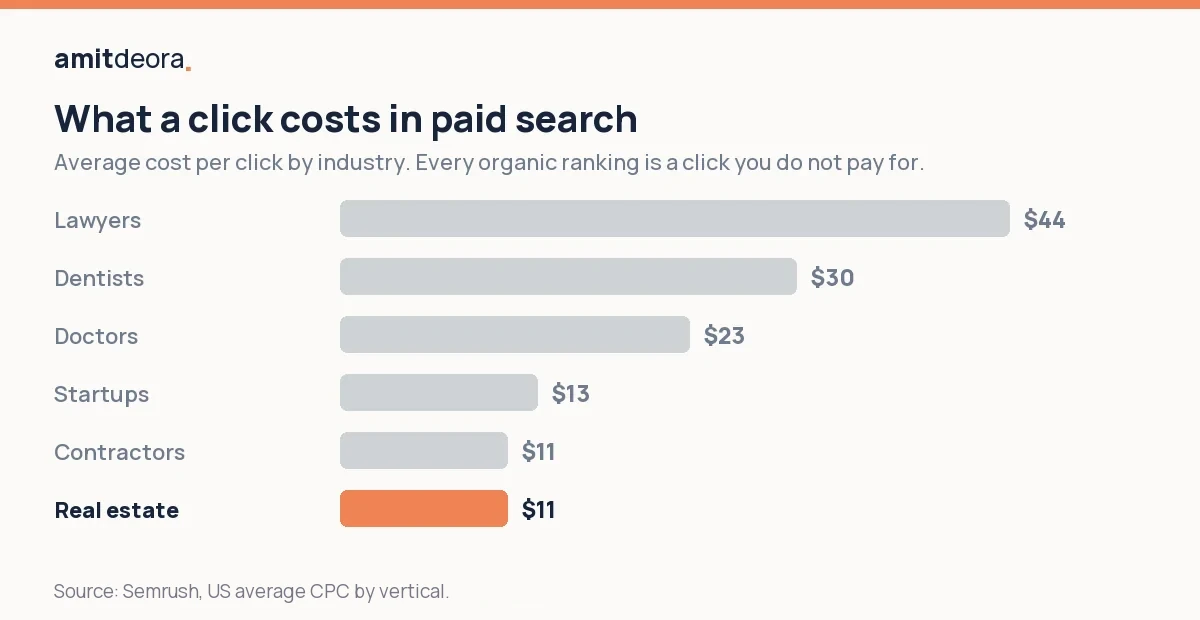
Use both. Paid ads and portal listings bring leads now, but you pay for every one and share them with other agents. SEO builds your own channel of exclusive leads that keeps working, and it builds your personal brand at the same time. For most agents, the smart order is a strong local-SEO and content base, with paid ads to fill short-term gaps. For the numbers, see how much SEO costs.
Why agents should care about AI search
Buyers and sellers now ask ChatGPT or Google’s AI answers about neighborhoods and the process of moving. Those tools quote clear, trusted, local content, which is exactly what your neighborhood pages and guides provide. So the content work above helps you show up in AI answers too. For the approach, see the GEO guide.
An honest note on experience
I will be straight with you. I have not published a real-estate case study, so I will not pretend to one. The closest real example is a local, service-led consultancy where the same basics, a clean profile, specific local pages, real reviews and tracking enquiries, helped grow inbound leads about 4 to 5 times (client-reported) over six months. The hyperlocal, trust-led playbook is the same one that works for an agent. You can see more in my case studies.
Common real estate SEO mistakes
- Chasing broad terms the big portals own, instead of hyperlocal searches.
- Thin neighborhood pages that only swap the suburb name.
- Leaving the Google Business Profile half-done.
- Ignoring reviews, the thing that most sways an agent choice.
- Posting generic content instead of real local guides.
- Judging SEO on traffic instead of booked leads.
The bottom line
For a real estate agent, SEO is not about beating the big portals. It is about owning the hyperlocal searches they cannot personalize: your neighborhoods, your name, and the local questions movers ask. Build a complete Google Business Profile, earn real reviews, write deep neighborhood pages, and become the local authority. Do that and you build a lead channel and a personal brand that keep working. To start, read local SEO for small businesses.
Want an honest look at where your biggest local search opportunity is? I am one click away.
Frequently asked questions
What is SEO for real estate agents?
SEO for real estate is the work of getting your website and profile to show up on Google when people search for an agent or for homes in your area. It covers local SEO, your Google Business Profile, reviews, and neighborhood and service pages. The goal is booked buyer and seller leads who find you through search, not just website traffic.
How do real estate agents get leads from Google?
Agents win leads by owning hyperlocal searches, like 'real estate agent [suburb]', 'homes for sale in [neighborhood]' and 'sell my house in [town]'. The big portals dominate broad terms, so focus on your specific areas with real neighborhood pages, a strong Google Business Profile and reviews. These bring buyers and sellers who want someone who knows their patch.
Can a real estate agent outrank Zillow or Rightmove?
Not for broad national terms, and you do not need to. You win on hyperlocal, agent-specific searches the portals cannot personalize, like a named neighborhood, your name, or 'best real estate agent in [town]'. Deep local content, your Google Business Profile and genuine reviews let you own the searches that turn into listings and buyer clients.
What content works for real estate SEO?
Hyperlocal content wins. Neighborhood guides, market updates for your area, 'cost of living in [town]' and 'best suburbs for families near [city]' attract buyers and sellers who are deciding where to move. Pair that with clear pages for your services, buying, selling and valuations, and link the content to those pages so it feeds real leads.
How long does real estate SEO take?
You can see early local wins in about 4 to 8 weeks, like a fixed Google Business Profile and better page titles. A steady flow of buyer and seller leads usually takes 3 to 6 months. Real estate is competitive, so deep local content and reviews build authority over time, but once they rank they keep bringing leads without paying per click.